Commercial Solar Street Lights: A Practical B2B Buyer’s Guide
Commercial solar street lights have moved from niche pilot projects to mainstream infrastructure. For importers, distributors, and project buyers, the question is no longer whether solar street lighting works, but how to specify, source, and deploy it profitably and reliably.
This guide breaks down what actually matters when purchasing commercial solar street lights: system architecture, component quality, performance calculations, supplier evaluation, and the mistakes that erode margins or trigger warranty claims. Whether you are sourcing for a municipal tender, a logistics park, or a distributor catalog, the decisions covered here will directly affect your project outcome.
How Commercial Solar Street Lighting Systems Work
A commercial-grade solar street lighting system is more than a panel bolted to a pole. It is an integrated, autonomous power and lighting unit engineered to operate for years with minimal intervention.
The core components:
| Component | Function | Key Quality Factors |
|---|---|---|
| Solar panel | Captures solar energy during daylight | Cell type (monocrystalline preferred), efficiency, lamination quality, frame durability |
| Battery | Stores energy for night operation | Chemistry (LiFePO4 is standard for commercial use), cycle life, thermal management |
| LED module | Produces light | Lumens per watt, optical distribution, heat dissipation, driver quality |
| Controller | Manages charging, discharging, and lighting profiles | MPPT vs PWM, programmable dimming, protection features |
| Pole and mounting | Physical support and alignment | Material, wind-load rating, corrosion protection, tilt-angle adjustability |
| Cabling and connectors | Links components | Weatherproofing, gauge, resistance to UV and moisture |
Why LiFePO4 Batteries Dominate Commercial Projects
Historically, solar street lights used lead-acid or gel batteries. Most serious manufacturers now supply LiFePO4 (lithium iron phosphate) batteries as standard for commercial applications. Reasons include:
- Longer cycle life — typically thousands of charge-discharge cycles, supporting multi-year service without battery replacement
- Higher depth of discharge — more usable capacity per cycle
- Safer chemistry — lower fire and thermal runaway risk than other lithium chemistries
- Wider temperature tolerance — better performance in hot and cold environments
- Lower weight and volume — simplifies pole-mounting and replacement
When evaluating a supplier, ask for the battery cell manufacturer, BMS (battery management system) specifications, and expected cycle life at your project’s ambient temperature range. Do not rely on marketing language alone.
Key Specifications B2B Buyers Must Evaluate
Not all commercial LED solar street lights are built to the same standard. A low upfront price often hides compromises in exactly the components that determine long-term performance.
1. LED Efficacy and Optical Design
LED efficacy is measured in lumens per watt (lm/W). Higher efficacy means more light for the same energy consumption — critical in solar applications where every watt-hour is limited by panel and battery size.
However, raw lumen output is less important than delivered lumens on the target surface. Optical design determines how evenly light is distributed across a road, pathway, or parking area. Ask for:
- IES or photometric files to verify lighting uniformity
- Simulated lux levels at your specific pole height, spacing, and road width
- Lens type (Type II, III, IV, V distributions) suited to the application
2. Solar Panel Sizing and Orientation
Panel wattage must be sufficient to recharge the battery during available sunlight hours — not just in summer, but in the worst-case month the system is expected to operate. Key points to verify:
- Panel wattage relative to battery capacity and LED load
- Tilt angle optimization for the installation latitude
- Shading analysis — even partial shade from buildings, trees, or adjacent poles can significantly reduce charging
A common failure mode is undersized panels. Suppliers should provide a charging calculation based on minimum sunlight hours at your project location, not a generic global average.
3. Battery Autonomy and Rainy-Day Performance
Autonomy refers to how many consecutive days the system can operate without meaningful solar charging. Commercial projects typically specify 3 to 5 days of autonomy, depending on location and criticality.
This figure is achieved by sizing the battery capacity relative to the nightly energy draw. But autonomy is not a free lunch: larger batteries cost more and take longer to fully recharge. Review the supplier’s charging-versus-consumption balance for your worst-case solar month.
4. Ingress Protection (IP) Ratings
For outdoor commercial solar lights, look for:
- IP65 or higher for the LED fixture — protects against dust and water jets
- IP65 or higher for the battery enclosure — often integrated into the fixture or a separate battery box
- IP67 for underground or buried components where applicable
IP ratings are self-declared in many cases. Reputable manufacturers can provide test reports or certification to back their claims.
5. Pole Height, Spacing, and Light Distribution
These three variables must be designed together. Typical ranges for commercial applications:
| Application | Common Pole Height | Typical Spacing | Notes |
|---|---|---|---|
| Residential streets | 4–6 m | 20–30 m | Low traffic, lower lux requirements |
| Collector roads | 6–8 m | 25–35 m | Moderate uniformity needed |
| Parking lots | 6–10 m | 3–4 × pole height | Wide-area distribution required |
| Industrial yards | 8–12 m | 30–50 m | High-output fixtures, often dual-arm |
Work with your supplier to match light distribution to pole spacing. Over-spacing causes dark zones; over-lighting wastes energy and increases system cost.
Comparing Commercial Solar Street Light Configurations
Buyers commonly face a choice between integrated and split-type designs. Both have legitimate commercial roles.
Integrated (All-in-One) Design
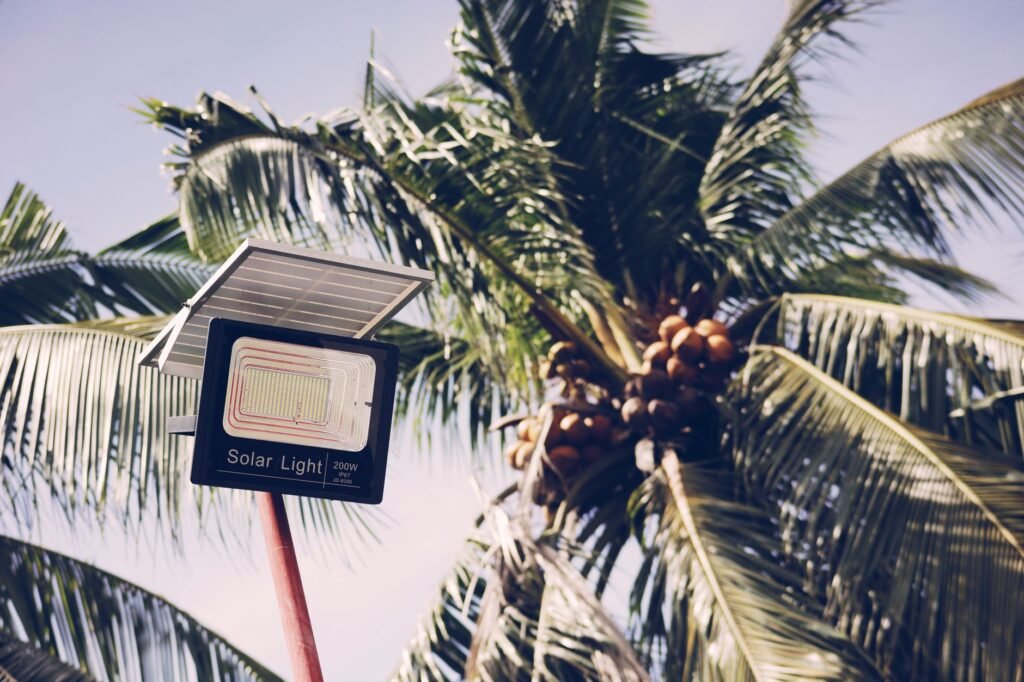
The panel, battery, LED module, and controller are housed in a single unit mounted on the pole.
Advantages:
- Faster installation and lower labor cost
- Cleaner aesthetic
- Simplified logistics and inventory
- Less exposed cabling to damage or theft
Limitations:
- Panel angle fixed to the unit’s design, which may not suit all latitudes
- Battery capacity constrained by the housing size
- Less flexible for high-wattage or high-autonomy projects
- Heat buildup concerns if thermal design is poor
Split-Type Design
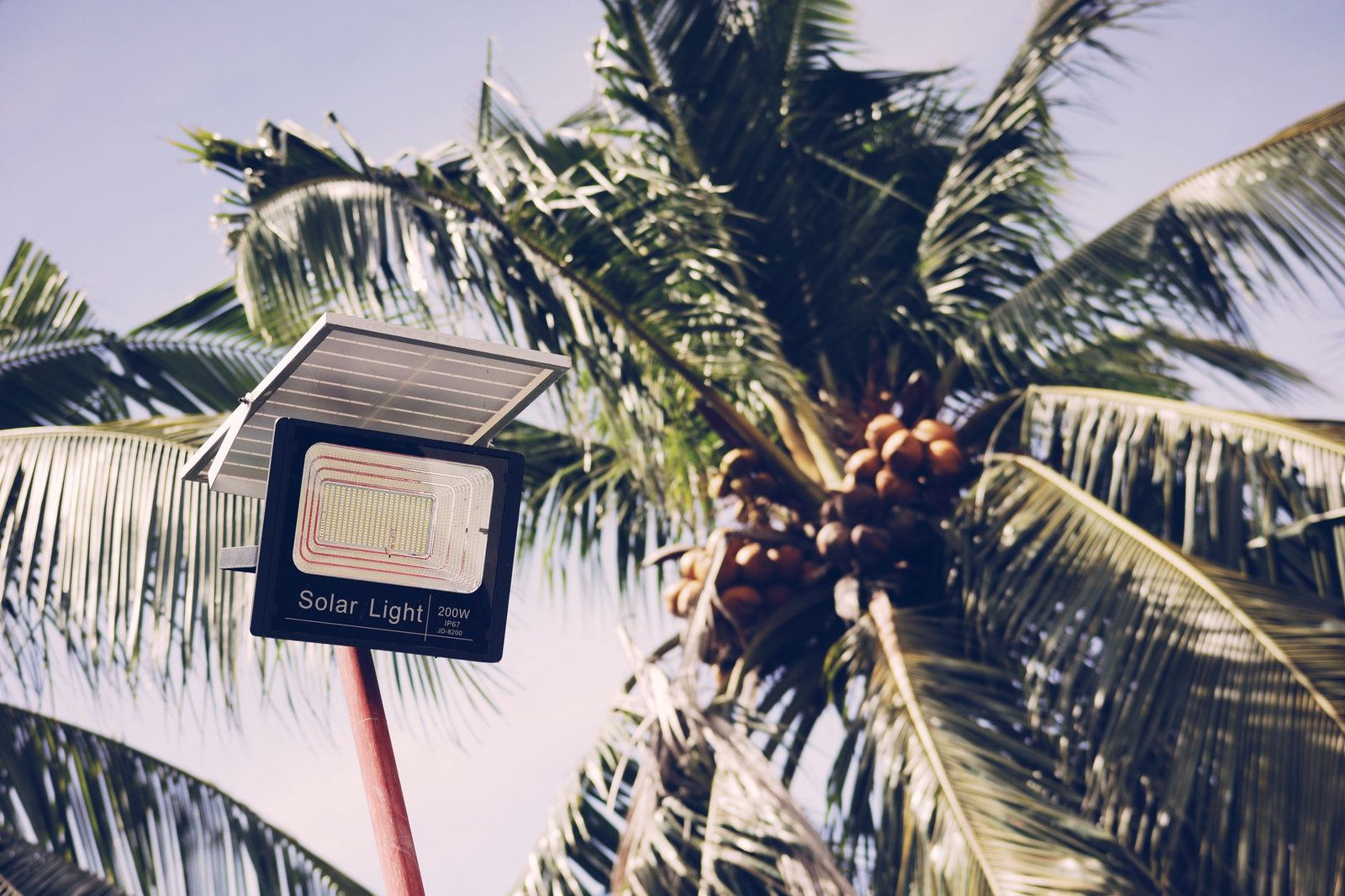
The panel is separated from the battery and LED fixture, allowing independent sizing and angle adjustment.
Advantages:
- Larger panels and batteries for high-power or long-autonomy applications
- Adjustable panel tilt for latitude optimization
- Easier battery maintenance or replacement
- Better heat dissipation with separate enclosures
Limitations:
- More complex installation
- Requires proper mounting of multiple components
- More cabling and connection points to weatherproof
Selection guidance: For standard roadway and pathway projects under roughly 60W of LED load, integrated designs often make sense. For high-power, extended autonomy, or extreme climate projects, split-type systems offer more design flexibility.
Common Purchasing Mistakes to Avoid
Experienced importers know that specification sheets do not always match real-world performance. Watch for these recurring problems:
1. Believing Peak Wattage Claims
A “100W solar street light” may refer to the LED rated power, but the actual running wattage after dimming profiles could be far lower. Verify:
- Total nightly energy consumption in watt-hours (accounting for dimming)
- Actual LED driver output, not the theoretical maximum of the LED chips
- Useful lumens, not raw lumens
2. Ignoring Local Climate in System Sizing
A system sized for southern Europe will not perform the same in northern Germany or coastal Southeast Asia. Temperature affects battery efficiency; cloud cover affects charging; humidity affects corrosion. Insist that suppliers size the system for your project’s worst-case conditions, not a standard template.
3. Overlooking Dimming and Control Programmability
Modern commercial solar street lighting systems include time-based or motion-sensor dimming. This is not a luxury — it is how systems achieve autonomy without oversized (and overpriced) batteries. Confirm that:
- Dimming profiles are programmable (not fixed at the factory)
- Motion sensor behavior matches your application (e.g., full brightness on detection, low-level background otherwise)
- Controller supports seasonal adjustments
4. Choosing Price Over Total Cost of Ownership
A cheaper system that requires battery replacement after two years will cost more over a five-year project than a well-engineered system with a higher upfront price. Evaluate:
- Component efficiency and expected degradation
- Battery cycle life and replacement cost
- Maintenance labor cost
- Warranty scope and enforceability
5. Failing to Verify Supplier Testing and Quality Control
Ask for:
- Component datasheets from the actual panel, battery, and LED manufacturers
- Photometric test reports (IES/LDT files)
- IP and IK test evidence
- In-house QC procedures and outgoing inspection protocols
- Reference projects with verifiable installations
Supplier Selection: What to Look For in a Manufacturer
When sourcing outdoor commercial solar lights for distribution or project delivery, the supplier’s engineering depth matters as much as their price list.
Evaluate these capabilities:
- In-house R&D and testing — Can they customize optical design, battery sizing, and pole integration? Do they have environmental testing chambers?
- OEM/ODM experience — Have they built products under other brands? Can they adapt to your market’s certification and labeling requirements?
- Component transparency — Will they disclose the panel cell brand, battery cell manufacturer, and LED chip source before you place an order?
- Documentation quality — Do they provide complete installation guides, spec sheets, photometric files, and warranty terms in a language you can use?
- Communication responsiveness — Technical questions should be answered with data, not just promises.
SUNLUX is a professional LED and solar lighting manufacturer serving B2B clients, including importers, distributors, contractors, and project buyers, with solar street light solutions designed for long service life and reduced maintenance. For technical consultation and project sourcing, buyers can request detailed specifications and quotation support directly from the SUNLUX team.
Frequently Asked Questions
1. How many hours per night can commercial solar street lights operate?
Operating hours are determined by system sizing: battery capacity, panel output, and LED consumption. Most commercial systems are specified for 10–12 hours of nightly operation, with dimming profiles reducing consumption during low-traffic hours. Confirm the supplier’s calculation includes your local solar conditions and specified autonomy days.
2. What is the typical lifespan of the battery in a solar street lighting system?
LiFePO4 batteries used in quality commercial solar street lighting systems are typically rated for several thousand charge-discharge cycles. Actual lifespan depends on depth of discharge per cycle, ambient temperature, and BMS quality. Ask the supplier for expected cycle life at your project’s temperature range before committing.
3. Can solar street lights work in cloudy or rainy climates?
Yes, provided the system is sized correctly. Panels still generate energy under diffuse light, though at reduced output. Systems for low-sunlight regions need larger panels, appropriate battery capacity, and realistic autonomy expectations. The supplier should size the system for the worst-case month at the installation site, not an annual average.
4. Are commercial solar street lights suitable for high-traffic roadways?
Solar systems can meet the illumination requirements of many road classifications, but the feasibility depends on required lux levels, pole spacing, and available sunlight. For high-speed or high-traffic roadways with demanding uniformity requirements, coordinate early with the supplier and request photometric simulations for your specific geometry.
5. What maintenance do solar street lighting systems require?
Routine maintenance includes panel cleaning (especially in dusty or coastal areas), inspection of connections and enclosures, and occasional battery health checks. Well-designed systems minimize maintenance, but no outdoor lighting product is truly maintenance-free. Include an annual inspection plan in project budgets.
6. How do I compare quotations from different suppliers fairly?
Compare total system configuration, not unit price alone. Normalize quotations by: LED efficacy and real nightly energy consumption, battery capacity and cell quality, panel wattage and type, controller features, IP ratings, warranty terms, and included accessories. A specification-level comparison prevents overpaying for underperforming systems or underbuying and paying later in failures.
7. Can solar street lights be customized for specific project requirements?
Yes. Professional manufacturers offer customization across pole height, light distribution, color temperature, dimming schedules, battery capacity, and panel wattage. For large projects, OEM/ODM options allow branding, tailored packaging, and project-specific documentation. Communicate your requirements clearly during the RFQ stage.
Conclusion
Commercial solar street lights are a mature, proven category — but successful procurement depends on specification discipline. Buyers who understand system sizing, component quality, photometric performance, and supplier capabilities will deliver projects that perform for years without excessive maintenance or premature battery replacement.
The difference between a profitable, repeatable product line and a costly warranty burden almost always comes down to the technical questions asked before purchase, not the purchase price itself.
Source with Confidence
If you are evaluating solar street lighting systems for import, distribution, or project delivery, SUNLUX provides B2B manufacturing support with a focus on technical transparency and long-term product reliability. Contact the SUNLUX team to request detailed specifications, photometric data, OEM/ODM cooperation options, and a project-specific quotation.