How to Choose the Right Solar Street Light for Large-Scale and Municipal Projects
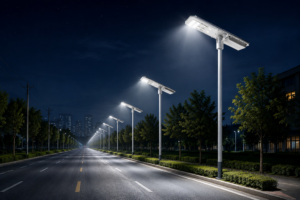
Selecting solar street lighting for commercial, municipal, or infrastructure projects is fundamentally different from buying a single residential unit. The decision affects installation costs, long-term maintenance budgets, public safety, and project compliance. Buyers need to evaluate not just the fixture itself, but the complete system: solar panel, battery technology, LED efficiency, control logic, pole configuration, and the supplier’s ability to support specification, logistics, and after-sales service.
This guide explains what importers, distributors, contractors, and project buyers should evaluate when sourcing solar street lighting at scale, and how to avoid the most common specification and procurement mistakes.
Why System Design Matters More Than Fixture Price
Many procurement teams start by comparing unit prices, but the unit price of a solar street light tells you almost nothing about its total cost of ownership or its real-world performance. A solar street light is an integrated power system. The LED module, solar panel, battery, charge controller, and pole must all be sized correctly for the installation site’s solar resource, required operating hours, and weather patterns.
A system that is under-specified will fail early, often within the first year. A system that is over-specified may be unnecessarily expensive. The right approach is to define performance requirements first, then ask suppliers to propose system configurations that meet those requirements. A competent manufacturer will ask about your location, required nightly operating hours, dimming schedules, and autonomy requirements before quoting.
For project buyers evaluating options, working with a manufacturer that offers solar street lights as an integrated system rather than a collection of separately sourced components simplifies technical review and warranty accountability. SUNLUX supplies complete solar street lighting solutions designed for OEM/ODM cooperation and project sourcing, which means one point of contact for system compatibility and technical documentation.
Defining Project Requirements Before Sourcing
Before contacting suppliers, document the following parameters. They will determine the system configuration and have a direct impact on cost.
Location and Solar Resource
The amount of usable solar energy varies significantly by region. A system designed for Southeast Asia may not perform adequately in Northern Europe or parts of North America without larger panels and batteries. Provide suppliers with the installation city or region and ask them to base their solar panel sizing calculation on local solar irradiance data.
Required Operating Hours
Municipal projects typically require full-output lighting from dusk to a set hour, followed by dimmed operation until dawn. A common profile is 4 hours at 100 percent brightness, then 8 hours at 30 to 50 percent. Some applications require full output all night. This profile directly affects battery capacity and panel size.
Rainy-Day Autonomy
Autonomy refers to how many consecutive days the system must operate without meaningful solar charging. Three to five days of autonomy is common for municipal projects, but this should be confirmed based on local weather patterns. Higher autonomy requires larger batteries and often larger panels.
Mounting Height and Road Classification
Pole height and road class determine the required lumen output and light distribution pattern. A 6-meter pole on a residential street needs far less output than a 10-meter pole on an arterial road. Buyers should reference local lighting standards where applicable.
Key Components to Evaluate
1. LED Module and Optical Design
LED efficiency is measured in lumens per watt (lm/W). Higher-efficiency LEDs deliver more light from the same panel and battery capacity, which reduces system size and cost. However, claimed lumen output should always be verified against actual system wattage and driver efficiency.
The optical design determines how light is distributed on the ground. Well-designed optics reduce wasted light, improve uniformity, and allow wider pole spacing. Ask suppliers for IES photometric files and review the lighting simulation for your specific road width and pole spacing.
What to verify:
- Real system wattage, not “equivalent wattage”
- Lumen maintenance and LED brand
- Driver efficiency and operating temperature range
- IES files and lighting simulation for your project parameters
2. Solar Panel
Most commercial solar street lights use monocrystalline panels, which offer higher efficiency per square meter than polycrystalline alternatives. Panel wattage should be sized based on the LED load, operating profile, and local solar conditions.
What to verify:
- Panel wattage and efficiency rating
- Glass quality and frame durability
- Whether the panel is matched to the battery and controller as a system
- Tilt angle suitability for the installation latitude
3. Battery Technology
Battery selection is the single most important reliability factor in solar street lighting. Two main technologies dominate the market:
| Battery Type | Advantages | Disadvantages |
|---|---|---|
| LiFePO4 (lithium iron phosphate) | Long cycle life, deep discharge capability, wide temperature range, lighter weight, no memory effect | Higher upfront cost than lead-acid alternatives |
| Lead-acid / gel | Lower initial cost | Shorter cycle life, heavier, limited depth of discharge, requires more maintenance, poor cold performance |
For most commercial and municipal projects, LiFePO4 batteries are now the default recommendation. They offer significantly longer service life and better performance across temperature extremes, which reduces replacement frequency and maintenance visits. The cost difference is often recovered within the first battery replacement cycle.
What to verify:
- Battery chemistry and cell brand
- Rated cycle life at a specified depth of discharge
- Operating temperature range
- Built-in battery management system (BMS) functions
- Whether the battery is field-replaceable
4. Charge Controller
The charge controller manages power flow between the panel, battery, and LED load. Look for MPPT (Maximum Power Point Tracking) controllers, which extract more energy from the panel than cheaper PWM controllers, particularly in variable weather conditions. The controller should also support programmable dimming profiles, dusk-to-dawn sensing, and over-charge/over-discharge protection.
What to verify:
- MPPT vs. PWM
- Programmable operating profiles
- Protection features and fault reporting
- Compatibility with remote monitoring systems if required
5. Enclosure and Ingress Protection
The IP rating indicates protection against dust and water ingress. For outdoor solar street lights, the LED housing and battery compartment should typically be rated IP65 or higher. In coastal or high-corrosion environments, additional surface treatment such as anodizing or specialized coatings may be necessary.
What to verify:
- IP rating for the luminaire housing and battery compartment
- IK (impact) rating for vandal-prone areas
- Corrosion resistance for coastal installations
6. Pole and Foundation
The pole must withstand local wind loads while supporting the panel and fixture. Pole height, wall thickness, base plate design, and foundation requirements should be confirmed with structural calculations. For retrofit projects where existing poles will be reused, the supplier should confirm compatibility of mounting brackets and panel orientation.
Common Purchasing Mistakes
Mistake 1: Comparing Unit Prices Without Comparing System Specifications
Two solar street lights may look identical in photos but differ significantly in panel wattage, battery capacity, LED efficiency, and controller quality. Always compare full system specifications, not just advertised wattage or lumen output.
Mistake 2: Ignoring Autonomy Requirements
A system that works well during sunny months may fail during extended cloudy periods. Confirm autonomy requirements with the supplier and verify the battery capacity calculation accounts for your worst-case weather conditions.
Mistake 3: Overlooking Dimming Profiles
Without programmable dimming, the system must be sized for full output all night, which increases cost. A well-designed dimming profile can reduce panel and battery requirements by 30 to 50 percent while maintaining adequate lighting levels during low-traffic hours.
Mistake 4: Choosing the Wrong Battery Chemistry to Save Upfront Cost
Lead-acid batteries may reduce initial procurement cost, but their shorter cycle life and higher maintenance requirements often lead to higher total cost within two to three years. For projects with a five-year or longer service expectation, LiFePO4 is almost always the more economical choice.
Mistake 5: Not Verifying Local Warranty Support
A warranty is only valuable if the supplier can honor it in your market. Ask about local service support, spare parts availability, and the process for warranty claims before placing a large order.
Mistake 6: Failing to Request Photometric Data
Without IES files and lighting simulations, you cannot verify that a fixture will meet your required light levels and uniformity. Reputable manufacturers provide this documentation on request.
OEM/ODM and Project Sourcing Considerations
For importers, distributors, and project buyers, the choice of manufacturing partner is as important as the product itself. Key considerations include:
- Customization capability: Can the manufacturer adjust panel wattage, battery capacity, pole design, or housing finish to meet project specifications?
- Certification support: Does the manufacturer hold relevant certifications for your target market, such as CE, RoHS, or specific regional approvals?
- Documentation quality: Are datasheets, photometric files, installation manuals, and warranty terms professionally prepared and readily available?
- Logistics and packaging: Are products packaged to prevent damage in transit, and can the supplier coordinate shipping to your destination port?
- Communication and responsiveness: Is there a clear point of contact for technical questions, order updates, and after-sales support?
SUNLUX operates as a B2B manufacturer and supplier, offering SUNLUX solar street light solutions for importers, distributors, and project-based buyers. The product line is designed to support specification-driven projects where system configuration matters as much as the fixture itself.
Frequently Asked Questions
What size solar street light do I need for my project?
System sizing depends on pole height, road width, required light levels, operating hours, and local solar conditions. Provide these parameters to your supplier and request a system calculation rather than selecting a product based on advertised wattage alone.
How many days of autonomy should I specify?
Three to five days is typical for most municipal and commercial projects. Areas with extended cloudy seasons or high-reliability requirements may benefit from five days or more. Confirm with your supplier how autonomy is calculated under their specifications.
Is LiFePO4 always better than lead-acid for solar street lights?
For most commercial projects, yes. LiFePO4 offers longer cycle life, deeper discharge capability, and better temperature tolerance. Lead-acid may still be acceptable for budget-constrained projects with short service expectations, but the total cost of ownership is usually higher.
Can solar street lights work in cold climates?
Yes, but the system must be designed for low-temperature operation. LiFePO4 batteries with proper thermal management perform well in cold conditions, whereas lead-acid batteries suffer significant capacity loss. Snow accumulation on panels should also be considered in system design and panel tilt.
How do I verify the lumen output of a solar street light?
Request IES photometric files and review the lighting simulation for your specific road geometry. Compare system wattage and LED efficiency rather than relying on marketing lumen figures, which may reference theoretical maximums rather than actual delivered light.
Are solar street lights suitable for highway lighting?
Solar street lights can be suitable for highways and arterials when properly specified, but higher mounting heights and traffic speeds demand higher lumen output and carefully designed optics. Projects of this scale require detailed engineering review and often benefit from pilot installations.
How long do solar street lights last?
The LED module and pole can last 15 years or more with proper construction. The battery is the primary wear item, with LiFePO4 batteries typically rated for 2,000 to 3,000 cycles or more, translating to roughly 5 to 8 years depending on usage patterns. Confirm cycle life and warranty terms with your supplier.
Conclusion
Choosing the right solar street light for a commercial or municipal project requires moving beyond unit price comparisons and evaluating the complete system: LED efficiency, panel sizing, battery chemistry, controller intelligence, and enclosure durability. The most successful projects define performance requirements upfront, request supplier calculations and photometric data, and select a manufacturing partner with the technical capability to support specification, customization, and after-sales needs.
When evaluating options, prioritize total cost of ownership over initial procurement cost, and verify that the supplier can provide documentation, customization, and support for the lifetime of the installation.
Contact SUNLUX for project specifications, system sizing recommendations, and OEM/ODM quotes on solar street lights and complete outdoor lighting solutions. Our team supports importers, distributors, contractors, and project buyers with technical documentation, photometric data, and tailored quotations.