Street lighting pole designs influence where a luminaire can be mounted, how far it projects over a road and how the installation fits its surroundings. For contractors, distributors and municipal buyers, the right choice begins with road geometry and lighting requirements, then moves to the pole structure and power system. A distinctive shape can support a project’s visual identity, but appearance alone cannot establish illumination, wind resistance or service life.
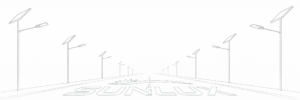
The SUNLUX illustration presents six configurations: A-frame solar, double-arm solar, self-bending dual-arm, human-shape, conical-shell and curved-arm. These are the descriptive labels used in the image, rather than universal engineering classifications. Use this guide to shortlist a configuration and prepare a precise request for quotation.
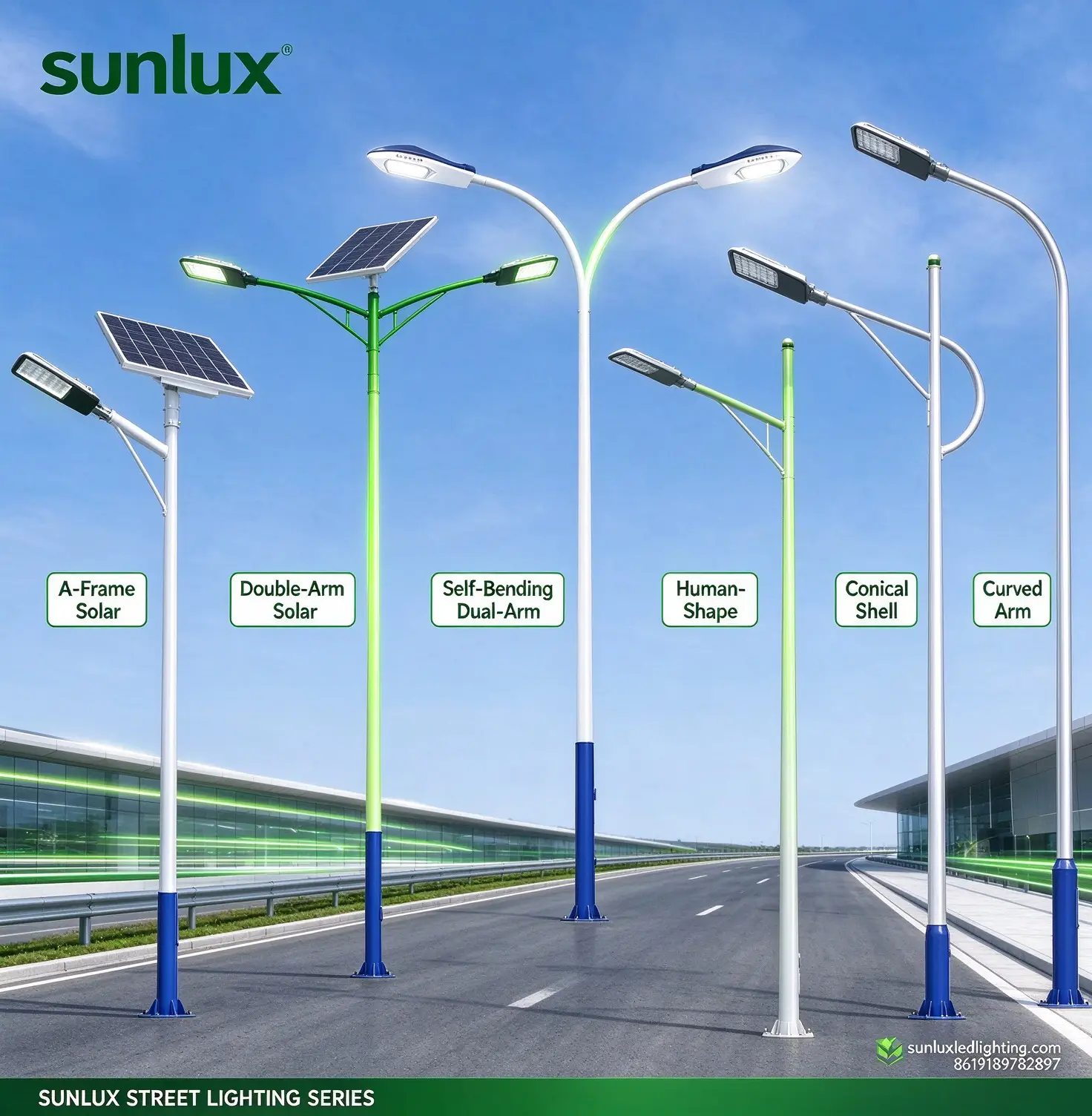
1. A-Frame Solar Street Lighting Pole
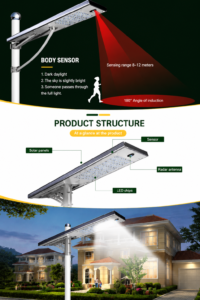
The illustrated A-frame solar arrangement combines a single lighting arm with a separate photovoltaic panel mounted above it. This configuration may be considered for local roads, access routes and other sites where an off-grid solution is being evaluated. The solar panel needs an appropriate orientation and an unobstructed exposure; the best direction for the light is not necessarily the best direction for the panel.
Before ordering, request the panel mounting detail, the battery location and the proposed operating schedule. Confirm that the lighting calculation and the solar energy assessment use the same night-time output profile. A panel shown in a catalogue image does not establish its rated power or the system’s autonomy.
2. Double-Arm Solar Street Lighting Pole
The double-arm solar design carries two luminaires with a shared solar arrangement. It offers a layout to investigate where light is needed on two sides of a pole, such as selected central positions between adjacent circulation areas. Suitability depends on the geometry and on whether each luminaire’s distribution reaches the intended surface.
Two light heads must be included in the energy calculation. Do not select battery capacity by copying the specification of a single-head model. Ask whether the luminaires operate together, follow separate schedules or use different outputs. The panel, brackets and both fixtures must also be included in the structural review.
3. Self-Bending Dual-Arm Street Lighting Pole
In the illustration, the self-bending dual-arm design has two sweeping arms that create a symmetrical outline. Buyers can consider this form for avenues, entrance roads or coordinated streetscape schemes where two-sided mounting is useful. The actual arm projection and separation should follow the lighting layout rather than the proportions of the promotional rendering.
Request an overall drawing showing mounting height, arm reach, fixture inclination and mounting connection dimensions. Check compatibility with the chosen luminaires. Symmetrical arms do not guarantee uniform lighting when road widths, setbacks or fixture optics differ on the two sides.
4. Human-Shape Street Lighting Pole
The human-shape label describes the angled-arm silhouette shown in the image. It may be shortlisted where a project calls for a more distinctive appearance while retaining a defined mounting position for a roadway luminaire. Treat its visual form as a design option to coordinate with the architect or public-realm designer.
The enquiry should clarify the arm connection, cable route, maintenance opening and fixture orientation. Ask for the exact fabrication drawing because a descriptive shape name does not identify the material, connection method or available dimensions. Review the final assembly with all fixtures and accessories included.
5. Conical-Shell Street Lighting Pole
The conical-shell label identifies the illustrated tapered-style pole and its light mounting arrangement. For procurement, translate that label into measurable details: shaft profile, base and top dimensions, material specification, wall thickness and connection details. A supplier drawing should establish what is actually being offered.
Different structures can have a similar external appearance. Avoid treating a taper or a larger visible base as proof of capacity. Request the design basis for the proposed configuration and coordinate its base interface with the project’s foundation designer.
6. Curved-Arm Street Lighting Pole
A curved-arm configuration places the luminaire on a sweeping extension from the shaft. It can be evaluated where a project needs a particular outreach or a continuous curved visual line. The arm’s reach affects the fixture position relative to the road, which should be checked in the photometric layout.
Specify the luminaire connection and the required mounting inclination. Confirm that the arm and fixture combination is included in the structural submission. If replacing existing lights, compare the new geometry with the original installation rather than assuming that a similar-looking arm is interchangeable.
How to Choose Between These Street Lighting Pole Designs
Start with a scaled drawing that identifies road widths, pedestrian areas, proposed pole positions and mounting restrictions. Set the required lighting criteria with the project designer, then compare calculations for the proposed luminaires and optics. Pole spacing should be supported by that assessment; there is no single spacing ratio that suits all six designs.
Next, establish the local wind design criteria and the complete equipment load. Hapco’s technical guidance identifies mounting height, weight, effective projected area and wind conditions as pole selection inputs. Apply the code and assumptions required for your project, rather than transferring another manufacturer’s catalogue rating to a SUNLUX configuration.
For solar options, define the site location, shading, seasonal charging conditions, required hours and dimming schedule. Fonroche’s design guidance likewise emphasises local climatic conditions and the expected lighting service. A sound comparison evaluates the complete solar system under stated conditions, rather than relying on a wattage label.
What to Include in Your Request for Quotation
Provide the project country and location, quantities, site plan, required mounting height, preferred configuration and fixture details. State whether the supply includes the pole only, a complete grid-powered assembly or a solar lighting system. Identify the required finish, colour, environmental conditions, control functions and delivery destination.
Ask each bidder to identify included arms, luminaires, anchor assemblies, electrical items, drawings and inspection documents. Request explicit exclusions and the procedure for approving substitutions. Compare quotations against the same scope so that a lower price is not simply the result of omitted equipment or documentation.
Frequently Asked Questions
Which pole design is best for a wide road? Road width alone is insufficient. Evaluate pole positions, mounting height, optics and the required lighting results together.
Are double-arm poles always more economical? They can consolidate mounting positions in a suitable layout, but the comparison must include the complete structure, foundation, cabling, luminaires and maintenance requirements.
Can every design in the illustration be supplied as solar-powered? The image explicitly labels two solar arrangements. Availability of other solar combinations should be confirmed against a project-specific proposal.
Can dimensions and ratings be taken from this image? No. It is a design illustration, not a dimensioned drawing or a test report. Confirm the final configuration and performance in the approved product and engineering documents.
Discuss Your Street Lighting Project with SUNLUX
Explore SUNLUX lighting pole solutions, outdoor LED lighting and solar lighting options. Send your site plan, preferred pole design and quantities to discuss the proposed supply scope and the information required for a project quotation.
Technical Reading
Hapco: pole design and application inputs; Fonroche Lighting: climate constraints and solar lighting design. These references explain general selection considerations; they do not certify the illustrated SUNLUX configurations.