A floodlight with the right wattage can still perform badly when its beam angle is wrong. Narrow beams concentrate light into a smaller area; wide beams distribute light across a larger zone. For stadiums, industrial yards and facades, the correct optic is determined by mounting distance, aiming geometry and a lighting calculation.
What beam angle describes
A beam angle commonly describes the angular width of the main light distribution under a defined photometric convention. It does not by itself state how many lux will reach the ground or whether a fixture will cause glare.
Manufacturers may offer symmetrical and asymmetrical optics. Two luminaires both described as wide-beam can perform differently because their intensity distributions are not identical.
Narrow-beam applications
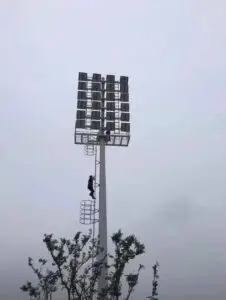
A narrower optic can help project light over longer distances or toward a defined target. This may be useful when fixtures are mounted far from a sports field or high above an industrial area. However, concentrated beams can create hot spots and discomfort if aiming is poor.
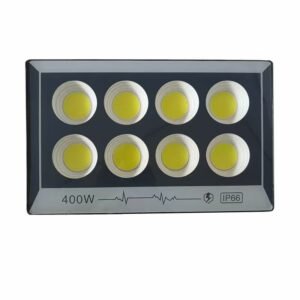
Do not choose a narrow beam only because it appears brighter in a product photo. Request the IES or LDT photometric file for the exact optic.
Wide-beam applications
A wider optic may cover nearby work areas, low-mounted building facades or broad zones where fixtures are relatively close to the target. But wide distribution can waste light outside the site boundary and increase spill light.
For perimeter installations, asymmetric optics may be more effective than a symmetrical wide beam because the light can be directed into the property.
Photometric and installation checks
- Mounting height and horizontal throw distance.
- Fixture position, tilt angle and target area.
- Required maintained illuminance and uniformity.
- Glare and spill-light limits for adjacent roads or homes.
- Exact optic and IES/LDT file, not only nominal watts.
- Luminaire weight, bracket aiming range and wind exposure.
Comparing supplier quotations
Request the same lighting target and calculation assumptions from every supplier. Compare the number of fixtures, total connected load, aiming angles and maintenance access. A lower-priced fixture is not necessarily cheaper if the design requires many more units.
Frequently Asked Questions
Does a smaller beam angle always mean higher lux?
Not at every point. Actual lux depends on optical distribution, distance, aiming and fixture output.
Can one beam angle serve both a stadium and a warehouse yard?
Possibly in some locations, but each layout needs its own photometric verification.
Is wattage enough to compare floodlights?
No. Compare efficacy, optics, photometry, durability and installation requirements.
Request a Project-Specific SUNLUX Quotation
SUNLUX Lighting supports project-based lighting and pole procurement. Share your site conditions, quantities, drawings or BOQ for a technical review. Email sales@sunluxledlighting.com or contact WhatsApp +8619189782897. Configuration, performance and certifications must be confirmed for the selected model.
Related SUNLUX guides: Wholesale floodlight selection, High mast lighting applications.