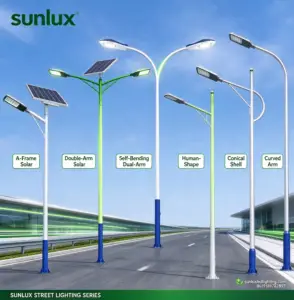
High mast lighting poles are not all the same. For overseas importers, EPC contractors and municipal buyers, the right design depends on three separate decisions: the shape of the steel mast, the arrangement of the floodlight headframe, and the maintenance access system. Mixing these categories can lead to an incomplete bill of quantities (BOQ) or a quotation that does not match the project drawing.
1. High Mast Pole Shapes: Round, Octagonal and Polygonal
Round Tapered High Mast Pole
A round tapered pole has a circular cross-section and gradually reduces in diameter toward the top. It provides a smooth appearance, but shaft dimensions and structural capacity must be engineered for the actual site.
Octagonal Tapered High Mast Pole
An octagonal tapered pole has eight sides. Fabricated steel plates are formed and welded into a tapered shaft. Octagonal designs are widely specified for lighting infrastructure, including project-specific high mast applications.
Multi-Sided Polygonal High Mast Pole
Polygonal masts may have 12, 16, 20 or other numbers of sides depending on the design. These are not different lamp-head shapes: they describe the cross-section of the pole shaft. Multi-section shafts may use engineered slip joints for transport and assembly.
Tubular and Lattice Structures
Tubular steel masts and lattice tower structures are additional structural approaches for selected projects. A lattice tower is structurally different from a conventional tapered monopole and should not be quoted as an interchangeable product without an approved design.
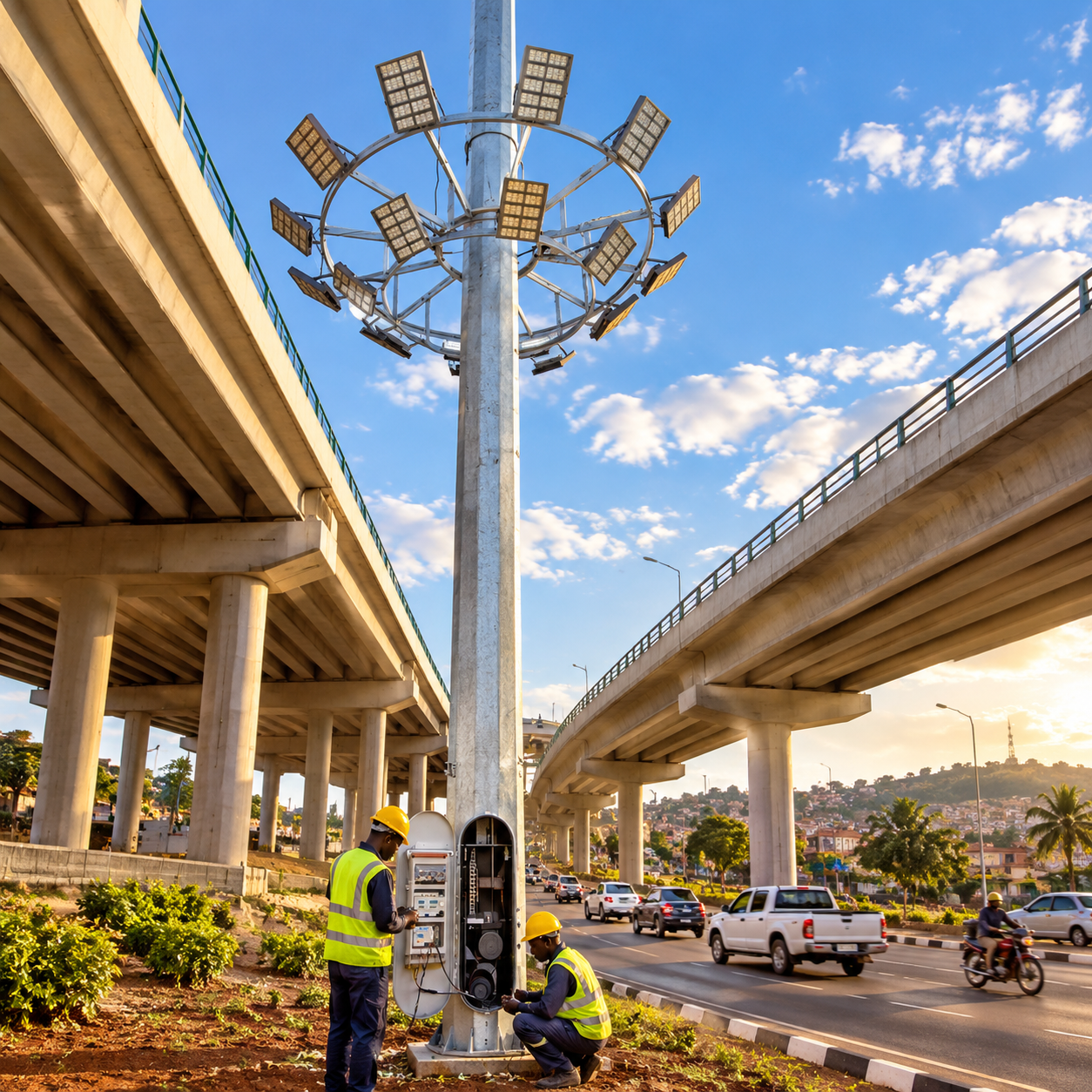
2. High Mast Headframe Shapes: Circular, Semi-Circular, Rectangular and Tiered
Circular Headframe / Ring
A circular luminaire ring positions floodlights around the mast, often for broad, multi-directional coverage at ports, junctions, yards and public areas. Circular rings may be fixed or form part of a raising-and-lowering carriage.
Semi-Circular or Partial-Ring Headframe
A semi-circular or partial-ring configuration concentrates floodlights over a selected sector rather than all around the pole. This can be a custom arrangement where light is needed primarily on one side. Ask the supplier for a layout drawing and photometric verification; it is not a universal standard model.
Rectangular and Single-Sided Headframes
Rectangular frames and single-sided arrangements are often relevant when luminaires need to aim toward a defined field or working area. Stadium and sports lighting projects may also use inclined or tilted frames to support the required aiming angles.
Double-Sided Headframes
A two-direction layout directs luminaires toward opposite areas. This describes the lighting direction, not necessarily the number of physical levels.
Double-Tier / Multi-Level Headframes
A double-tier headframe positions luminaires at two vertical levels. This is a custom engineered configuration, not an automatic upgrade over a single-tier ring. Engineers must review wind-exposed area, total weight, aiming, maintenance access and structural connections.
Crossarm and Multi-Arm Arrangements
Crossarms or multiple brackets may support fewer luminaires or serve particular aiming directions. Their design must account for total luminaire loads and wind forces.
3. Fixed vs Raising-and-Lowering High Mast Systems
Fixed headframe: Luminaires stay at the top. Maintenance may require a ladder, service platform, removable climbing steps or approved lifting equipment. Lowering headframe: A winch, ropes, pulleys and carriage enable the lighting assembly to be brought down for servicing. The selected method affects purchase cost, maintenance planning and accessory requirements.
4. Which High Mast Type Should International Buyers Choose?
| Project | Headframe approach to evaluate | Important purchasing checks |
|---|---|---|
| Port or container yard | Circular or directional ring | Corrosion protection, glare, wind loading, access |
| Stadium or sports ground | Rectangular, tilted or directional frame | Photometric aiming, spill light, maintenance platform |
| Highway interchange | Circular or lowering ring | Lighting distribution, traffic-safe maintenance |
| Industrial plant | Fixed or lowering headframe | Equipment clearance, electrical protection, access |
| Public square | Multi-directional ring | Visual impact, uniformity, local regulations |
These are starting points, not fixed design rules. The correct choice comes from the project specification, structural design and lighting calculation.
5. High Mast Pole Accessories to Specify in an RFQ
- Pole height, steel grade, cross-section and number of sections
- Base flange, anchor bolts, nuts, washers and template
- Headframe shape, number of luminaire positions and bracket details
- Access ladder, fall protection, maintenance platform and guardrails where required
- Maintenance door, removable panel, internal cables and cable clamps
- Fuse holders, junction boxes, grounding and lightning protection as designed
- LED floodlights, driver specifications, optics and photometric files
- Galvanizing/coating specification and design wind speed
- Lowering winch, suspension ropes, pulleys and locking system if applicable
6. Questions Overseas Importers Should Ask Before Ordering
- Is the quoted shape the mast shaft shape or the headframe shape?
- Is the headframe fixed, manual lowering or motorized lowering?
- Does the quotation include ladder, platform, guardrails and foundation hardware?
- Are wind speed, soil conditions, luminaire weight and lighting calculations confirmed?
- Will the supplier provide approved fabrication drawings and a detailed BOQ before production?
Frequently Asked Questions
Is an octagonal high mast the same as a circular headframe?
No. Octagonal describes the shaft cross-section; circular describes the arrangement of the lights at the top. One high mast can have an octagonal shaft and a circular headframe.
Is a double-tier headframe better than a single-tier design?
Not automatically. The design must meet photometric, structural and maintenance requirements. Additional tiers can increase wind-exposed area and structural complexity.
Do all high mast poles need a maintenance ladder?
No. A lowering-headframe system may enable ground-level maintenance. Fixed systems may use ladders, platforms or other approved access methods.
Get a Project-Specific High Mast Pole Quotation from SUNLUX
SUNLUX Lighting supplies customized steel lighting poles and LED floodlighting solutions for importers, engineering contractors and infrastructure projects. Share your BOQ, project drawings, wind-speed requirement, pole height and preferred headframe arrangement for technical review and quotation.
Email sales@sunluxledlighting.com or contact WhatsApp +8619189782897.
More reading: High Mast Pole Components and Accessories; 20m vs 22m High Mast Pole BOQ Guide; Port High Mast Lighting Design.
Technical References
Industry configurations referenced in the research include Streetscape lowering headframe masts, high mast lighting system configurations, and Abacus high mast headframes and platforms. These are technical background references, not endorsements or claims that SUNLUX manufactures every illustrated configuration.